
Maxim Dumitraș. Encircled absences. Objects of betterment.
Jul-17
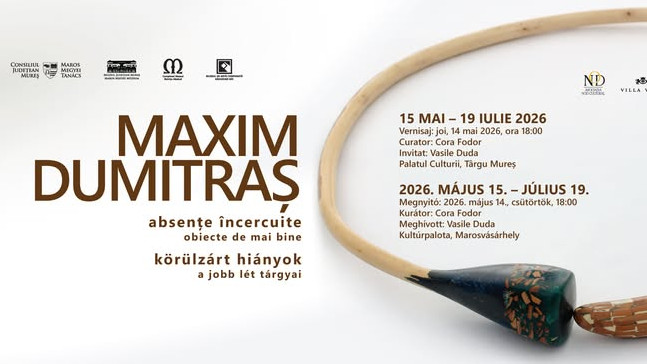
The Mureș County Museum respectfully invites the public to the opening of Maxim Dumitraș’s exhibition *Encircled Absences. Objects of Better Living*, taking place on Thursday, May 14, 2026, at 6:00 PM at the Palace of Culture.
The exhibition will be open to visitors from May 15 to July 19, 2026.
The exhibition — Maxim Dumitraș’s first solo show in Târgu Mureș — presents a selection of the artist’s works, offering a comprehensive view of his distinctive sculptural vision. In his practice, tradition, contemporary visual language, and meaning form an organic unity. His works originate from concrete materials — wood, stone, metal, steel, wicker, or adobe — and evolve toward a more refined and essential form of expression, where mass transforms into tension, direction, and energy.
This approach — creating a dialogue between traditional and contemporary forms, also reflected in the concept of the Comparative Art Museum of Sângeorz-Băi founded by the artist — permeates the entire exhibition. Some of the exhibited works function as installations, incorporating ethnographic objects and placing them into new contexts, endowing them with renewed meanings within sculptural forms. Throughout, the artist’s vision remains coherent, linking the memory of materials with contemporary modes of expression.
One of the exhibition’s defining sections is the series *Encircled Absences*, in which form not only delineates emptiness but also sets it in motion. This void becomes charged with meaning through the viewer’s gaze, while absence itself turns into presence. In parallel, the cycle *Objects of Better Living* focuses on the relationship between the artist and living matter: wood here is not merely a material, but a once-living, changing entity bearing the traces of slow transformation. In this process, artistic intervention and the workings of nature become deeply intertwined.
Maxim Dumitraș’s artistic vision is shaped by the tension between weight and levitation, material constraint and the desire to transcend it, as well as the search for balance between earth and sky. A recurring element in his works is the color blue, serving as both a visual and symbolic link between different planes.
The exhibition is organized by the Art Department of the Mureș County Museum in collaboration with the Comparative Art Museum of Sângeorz-Băi. The Ethnography and Folk Art Department also contributes to the project with objects on loan from its own collection.
Curator: Cora Fodor, art historian
Guest speaker: Vasile Duda, art historian
Partner organization: Nod Cultural Association
The exhibition will be open to visitors from May 15 to July 19, 2026.
The exhibition — Maxim Dumitraș’s first solo show in Târgu Mureș — presents a selection of the artist’s works, offering a comprehensive view of his distinctive sculptural vision. In his practice, tradition, contemporary visual language, and meaning form an organic unity. His works originate from concrete materials — wood, stone, metal, steel, wicker, or adobe — and evolve toward a more refined and essential form of expression, where mass transforms into tension, direction, and energy.
This approach — creating a dialogue between traditional and contemporary forms, also reflected in the concept of the Comparative Art Museum of Sângeorz-Băi founded by the artist — permeates the entire exhibition. Some of the exhibited works function as installations, incorporating ethnographic objects and placing them into new contexts, endowing them with renewed meanings within sculptural forms. Throughout, the artist’s vision remains coherent, linking the memory of materials with contemporary modes of expression.
One of the exhibition’s defining sections is the series *Encircled Absences*, in which form not only delineates emptiness but also sets it in motion. This void becomes charged with meaning through the viewer’s gaze, while absence itself turns into presence. In parallel, the cycle *Objects of Better Living* focuses on the relationship between the artist and living matter: wood here is not merely a material, but a once-living, changing entity bearing the traces of slow transformation. In this process, artistic intervention and the workings of nature become deeply intertwined.
Maxim Dumitraș’s artistic vision is shaped by the tension between weight and levitation, material constraint and the desire to transcend it, as well as the search for balance between earth and sky. A recurring element in his works is the color blue, serving as both a visual and symbolic link between different planes.
The exhibition is organized by the Art Department of the Mureș County Museum in collaboration with the Comparative Art Museum of Sângeorz-Băi. The Ethnography and Folk Art Department also contributes to the project with objects on loan from its own collection.
Curator: Cora Fodor, art historian
Guest speaker: Vasile Duda, art historian
Partner organization: Nod Cultural Association
